Posts

Showing posts with the label Routing Protocols

Cisco ASA 9.0 Network Address Translation

http://www.cisco.com/en/US/docs/security/asa/asa90/configuration/guide/nat_overview.html http://www.cisco.com/en/US/docs/security/asa/asa90/configuration/guide/asa_90_cli_config.html http://www.pcausa.com/Utilities/pcattcp.htm

Enhanced Interior Gateway Routing Protocol (EIGRP)

Image
Enhanced Interior Gateway Routing Protocol (EIGRP) is an Open standard routing protocol loosely based on their original IGRP created by Cisco. Most of the routing optimizations are based on Diffuse Update Algorithm (DUAL), which guarantees loop-free operation and provide a mechanism for fast convergence. EIGRP has following features: Simple configuration Flexibility in summarization Unequal cost load balancing Scalability Authentication VLSM support Keeps Backup routes Incremental updates EIGRP is the only routing protocol which keeps backup routes in its topology table. So when the primary route fails, it pick that backup route from the topology table and puts it into the routing table, eliminating the need of querying a new route from neighbors on failure on primary link, which results in fast convergence.

Default Administrative Distances

Default Administrative Distances (AD Values) Route Source Default Distance Connected interface 0 Static route 1 EIGRP summary route 5 External BGP 20 Internal EIGRP 90 IGRP 100 Open Shortest Path First (OSPF) 110 Intermediate System-to-Intermediate System (IS-IS) 115 Routing Information Protocol (RIP) 120 Exterior Gateway Protocol (EGP) 140 EIGRP external route 170 Internal Border Gateway Protocol (BGP) 200 Unknown 255 To display the default administrative distance for a specified routing process, use the show ip protocols EXEC command.

BGP Confederation

Image
The implementation of BGP Confederations reduces the iBGP mesh inside an AS. The trick is to divide an AS into multiple ASs and assign the whole group to a single confederation. Each AS alone has iBGP fully meshed and has connections to other ASs inside the confederation. Even though these ASs have eBGP peers to ASs within the confederations, the ASs exchange routing as if they used iBGP. In this way, the confederation preserves next hop, metric, and local preference information. To the outside world, the confederation appears to be a single AS. In order to configure a BGP confederation, issue this command: bgp confederation identifier autonomous-system The confederation identifier is the AS number of the confederation group. The execution of this command performs peering between multiple ASs within the confederation: bgp confederation peers autonomous-system [autonomous-system] Here is an example of confederation: Confederation

BGP Route Reflectors

Image
Rules says that, routes learned via iBGP will never be advertised to another iBGP peer in normal conditions. One way to overcome this rule is to create a full mesh topology among iBGP peers. But in some conditions this is not feasible due to many reasons. So an alternative to BGP full mesh topology is Route Reflectors, which allows a router to advertise, or reflect, iBGP learned routes to other iBGP speakers. This route reflection reduces the number of iBGP peers within an AS. In normal cases, maintain a full iBGP mesh among RTA, RTB and RTC within AS 100. If you utilize the RR concept, RTC can be elected as an RR. In this way, RTC has a partial iBGP peering with RTA and RTB. Peering between RTA and RTB is not necessary because RTC is an RR for the updates that come from RTA and RTB. neighbor A.B.C.D route-reflector-client

Open Shortest Path First (OSPF)

Image
The Open Shortest Path First (OSPF) is an Interior Gateway Protocol used to distribute routing information within a single Autonomous System. OSPF is a Link State routing protocol and has following features. Fast convergence VLSM support Scalable to large networks Stub capabilities Authenticaion Efficiency (Sends only hello messages to maintain neighbor relationship) Route tagging capabilities Uses multicast for routing updates. Specifications                              Protocol type            Link-state               Administrative Distance            110                                          Metric          ...

OSPF Neighbor States

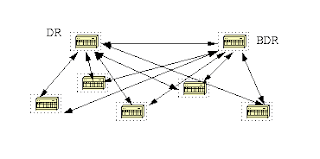
When OSPF adjacency is formed, a router goes through several state changes before it becomes fully adjacent with its neighbor. Those states are defined below: Down This is the first OSPF neighbor state. It means that no hellos have been received from this neighbor, but hello packets can still be sent to the neighbor in this state. Attempt This state is only  valid for manually configured neighbors in an NBMA environment. In Attempt state, the router sends unicast hello packets every poll interval to the neighbor, from which hellos have not been received within the dead interval.

OSPF Stub and NSSA configuration

Image
Scenario: You have been hired as a Network Engineer in an International Chemical Company. They have been running OSPF for very long time.  External routes are redistributed on router R1 which are propagating all through the OSPF domain. Recently they have done partnership with one of the Local Export company which run RIP in their Network. Objectives: For efficiency, configure area 50 as a Stub. Redistribute RIP routes on R4 into OSPF domain. Configure area 50 as a nssa. Make sure that the area 50 can reach the External routes redistributed through Backbone ASBR. Topology :

OSPF Special Areas

To understand the OSPF Area types, first let's have a breif review of OSPF LSA types. For deep understanding of LSA types, visit  Understanding OSPF Link-state Advertisement . Routers generate different types of LSAs depending on the router's role within the OSPF Autonomous Systesm. LSA type 1 (Router LSA) Generated by all routers in an area to describe their directly attached links (Intra-area routes). These LSAs do not leave the area. LSA type 2 (Network LSA) Generated by the DR of a segment to describe the neighbors connected to the segment. These LSAs do not leave the area.

BGP Route Refresh and Soft-Reconfiguration for Inbound Policy Update

Image
Whenever there is a change in routing policy, the BGP session must be reset (cleared) for the new policy to take effect and the routing table  to be configured. Using a hard reset to clear a BGP session causes cache invalidation and results in a negative impact on network. We can use the following three methods to reset the BGP session: Hard reset : dropping and re-establishing TCP session to our peers. Dynamic Soft reset : uses the route-refresh capability to request all NLRI be sent again. Soft reset using stored information : uses the unmodified and unfiltered stored updates.

Filtering Routes in BGP using Route-maps and Prefix-list

Image
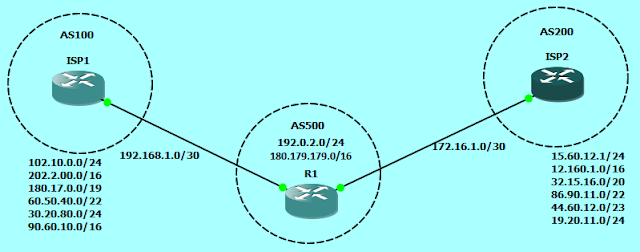
Order of preference of attributes in BGP The order of preference varies based on whether the attributes are applied for inbound updates or outbound updates. For inbound updates the order of preference is:     route-map     filter-list     prefix-list, distribute-list For outbound updates the order of preference is:     prefix-list, distribute-list     filter-list     route-map NOTE: The attributes prefix-list and distribute-list are mutually exclusive, and only one command (neighbor distribute-list or neighbor prefix-list) can be applied to each inbound or outbound direction for a particular neighbor. Scenario: We own the AS500 and advertising a network block of 192.0.2.0/24 and 180.179.179.0/16 to two different ISPs.

Border Gateway Protocol (BGP)

Image
Introduction Border Gateway Protocol is an Exterior Gateway Protocol (EGP) used for routing between the autonomous systems. It is the protocol which is used to to make core routing decisions on the internet. BGP has two flavours, eBGP and iBGP. eBGP is routing between the autonomous systems and iBGP is routing within an autonomous systems. BGP is a path-vector routing protocol and has following features: Reliable updaes (TCP -based, port 179) Triggered updates only Rich metric Scalable to massive networks   Specifications              Protocol Type                Path-vector                    eBGP AD                20                     iBGP AD                200           ...

Distance-Vector, Link-State and Path-Vector

Distance-Vector Routing Protocol A distance-vector routing protocol requires that a router inform its neighbors of topology change periodically.  Routers running Distance-vector routing protocols knows only what his neighbors tells him. They do not have knoledge of the entire path to a destination. Instead they use two methods:               • Direction in which router or exit interface a packet should be forwarded.              • Distance from its destination. Distance-vector routing protocols have less computational complexity and message overhead. Protocols: RIP

BGP Best Path Selection

Border Gateway Protocol (BGP) routers typically receive multiple paths to the same destination. The BGP best path algorithm decides which is the best path to install in the IP routing table and to use for traffic forwarding. The best route selection criteria occurs in the following order: Exclude any route with inaccessible next hop Prefer the path with the highest weight (local to router, Cisco-proprietary parameter) Prefer the path with the highest Local Preferance. (global within autonomous system) Prefer the path that was locally originated. (including redistributed routers from IGP) Prefer the path with the shortest AS_PATH (compare length only) Prefer the path with the lowest origin type (IGP < EGP < Incomplete) Prefer the path with the lowest multi-exit discriminator (MED) Prefer eBGP over iBGP paths. Prefer the path whose next-hop address has the lowest IGP metric Multipath determination For external BGP (eBGP) paths, prefer the oldest path Prefer pa...