Posts

Showing posts with the label OSPF

Basic Datacenter Design with Redundancy (Colocation Datacenter)
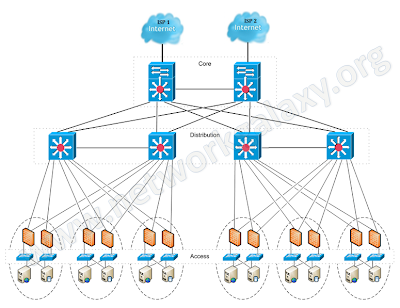
Image
The very basic thing that an organization expects while designing its network is maximum uptime, and this maximum uptime can only be achieved when there is redundancy in the network. So in this article, we'll design a network for a company hosted in a datacenter with redundant devices and links. NOTE: The configuration of devices in this article does not include configuration for securing the control-plane of core or aggregation routers. Full Network topology:
Open Shortest Path First (OSPF)

Image
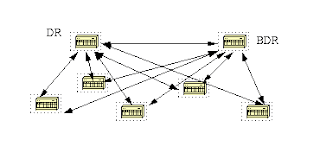
The Open Shortest Path First (OSPF) is an Interior Gateway Protocol used to distribute routing information within a single Autonomous System. OSPF is a Link State routing protocol and has following features. Fast convergence VLSM support Scalable to large networks Stub capabilities Authenticaion Efficiency (Sends only hello messages to maintain neighbor relationship) Route tagging capabilities Uses multicast for routing updates. Specifications                              Protocol type            Link-state               Administrative Distance            110                                          Metric          ...

OSPF Neighbor States

When OSPF adjacency is formed, a router goes through several state changes before it becomes fully adjacent with its neighbor. Those states are defined below: Down This is the first OSPF neighbor state. It means that no hellos have been received from this neighbor, but hello packets can still be sent to the neighbor in this state. Attempt This state is only  valid for manually configured neighbors in an NBMA environment. In Attempt state, the router sends unicast hello packets every poll interval to the neighbor, from which hellos have not been received within the dead interval.

OSPF Stub and NSSA configuration

Image
Scenario: You have been hired as a Network Engineer in an International Chemical Company. They have been running OSPF for very long time.  External routes are redistributed on router R1 which are propagating all through the OSPF domain. Recently they have done partnership with one of the Local Export company which run RIP in their Network. Objectives: For efficiency, configure area 50 as a Stub. Redistribute RIP routes on R4 into OSPF domain. Configure area 50 as a nssa. Make sure that the area 50 can reach the External routes redistributed through Backbone ASBR. Topology :

OSPF Special Areas

To understand the OSPF Area types, first let's have a breif review of OSPF LSA types. For deep understanding of LSA types, visit  Understanding OSPF Link-state Advertisement . Routers generate different types of LSAs depending on the router's role within the OSPF Autonomous Systesm. LSA type 1 (Router LSA) Generated by all routers in an area to describe their directly attached links (Intra-area routes). These LSAs do not leave the area. LSA type 2 (Network LSA) Generated by the DR of a segment to describe the neighbors connected to the segment. These LSAs do not leave the area.

Distance-Vector, Link-State and Path-Vector

Distance-Vector Routing Protocol A distance-vector routing protocol requires that a router inform its neighbors of topology change periodically.  Routers running Distance-vector routing protocols knows only what his neighbors tells him. They do not have knoledge of the entire path to a destination. Instead they use two methods:               • Direction in which router or exit interface a packet should be forwarded.              • Distance from its destination. Distance-vector routing protocols have less computational complexity and message overhead. Protocols: RIP

Understanding OSPF Link-state Advertisement

Image
LSA Overview Routers generate different types of LSAs depending on the router's role within the OSPF Autonomous System. All OSPF  routers create Router LSAs (Type-1) Designated routers create Network LSAs (Type-2) Area-Border routers create Summary LSAs (Type-3) Area Border routers create ASBR-Summary LSAs (Type-4) when an ASBR is known. Autonomous-System Boundary routers create External LSAs (Type-5 and Type-7)